
The faults we are called out for most often across the city, what usually causes each one, and whether it needs attention today or can wait. Written by the mobile mechanic Miami FL drivers call, so you can tell the difference before it strands you. Call 786-504-7447 and we come to you.
Most car faults give warning before they leave you somewhere inconvenient. The problem is that the warnings all feel similar, so a grinding brake and a squealing brake get treated the same way, when one is urgent and the other is not.
Each section below gives the symptom in plain terms, the causes that actually turn out to be responsible, and a straight answer on urgency. None of it is a diagnosis of your car, because that needs testing. It is here so you can judge how quickly to act.
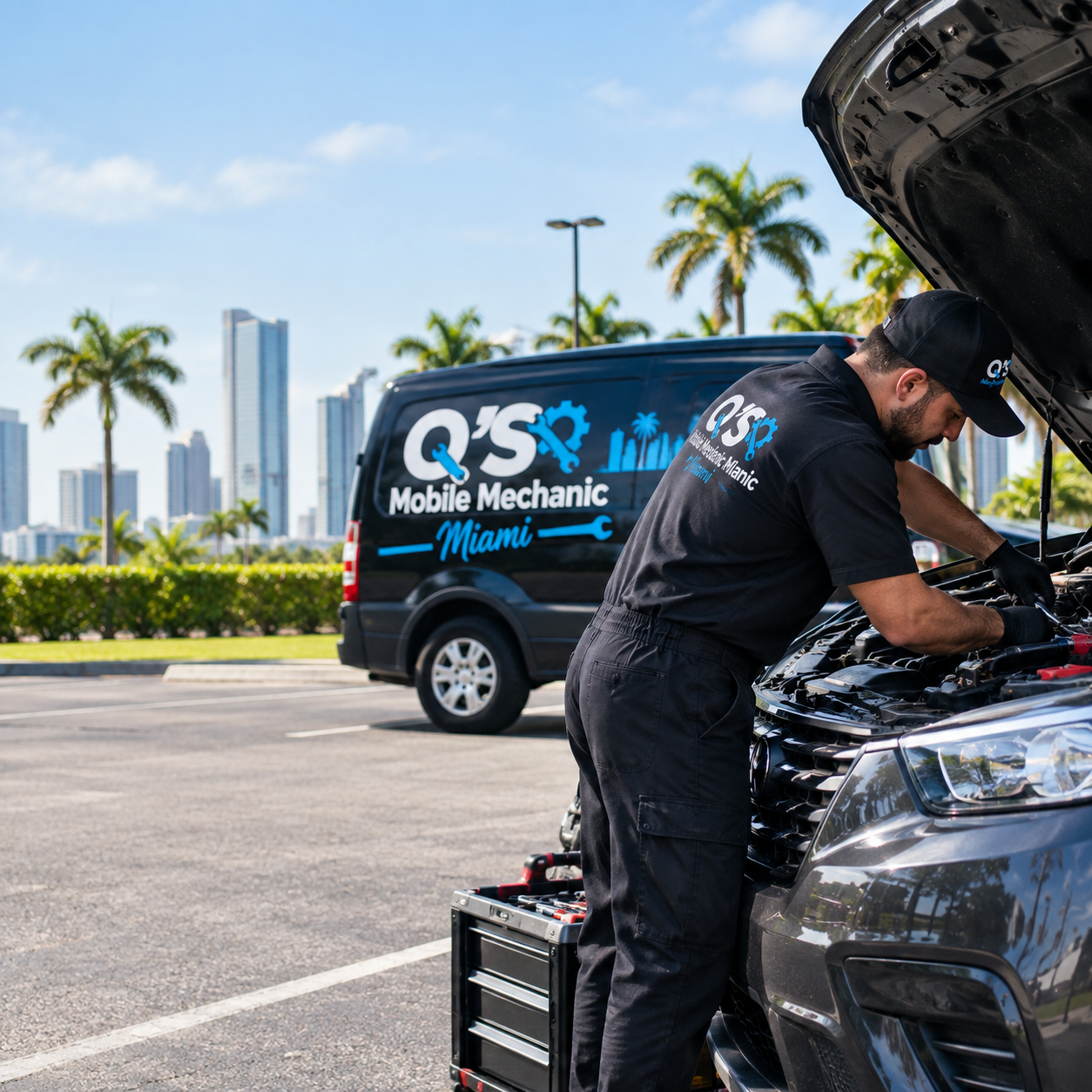
What you notice: Nothing happens, or the engine turns over slowly. Lights and dash may still work normally.
What usually causes it: A battery that no longer holds charge, corroded terminals, a charging fault that has been undercharging it for weeks, or a starter. These look identical from the seat.
What to do: Call before jump starting it repeatedly. A load test on the battery and an output check on the alternator separates them in minutes, and the repair can be done where the car sits.
What you notice: Cold at first then warm, warm only at idle, or no cold air at all. Common in Miami traffic.
What usually causes it: Low refrigerant from a leak, a condenser fan not running, a blocked cabin filter, an icing evaporator or a compressor clutch not engaging.
What to do: Do not just have it topped up. A sealed system does not consume refrigerant, so if it is low it leaked, and refilling without finding the leak means paying twice.
What you notice: The check engine light is on but the car drives normally.
What usually causes it: Hundreds of possibilities, from a loose fuel cap to an upstream exhaust leak skewing the mixture readings. The light records something the system genuinely saw.
What to do: Get the codes read rather than ignoring it or clearing it. Some are a note for the next service, others are quietly damaging a catalytic converter.
What you notice: A squeal that comes and goes, or a grinding you can feel through the pedal.
What usually causes it: Worn pads is the common one. Grinding usually means the friction material is gone and metal is contacting the disc. A squeal can also be glazing or a worn wear indicator.
What to do: Grinding is a call now, not next week, because it damages discs and lengthens stopping distance. A squeal is worth checking at the next convenient visit.
What you notice: The level drops with no obvious puddle, or the temperature gauge creeps up in traffic.
What usually causes it: A weeping hose or water pump seal, a plastic radiator end tank, a thermostat, a fan not running, or air trapped in the system after a previous repair.
What to do: Stop driving it hot. Heat is what turns a hose job into a head gasket job. A cold pressure test finds the loss without guessing.
What you notice: A knock from one corner over expansion joints or speed bumps, often worse at low speed.
What usually causes it: Sway bar links, worn bushings, a ball joint with play, or a tired strut mount.
What to do: Not usually urgent, but it is ruining tires continuously and it lengthens braking. Worth having the corner checked by hand rather than waiting.
What you notice: Revs rise without the car pulling, a thump into gear, or a pause before it engages.
What usually causes it: Low or burnt fluid, a solenoid, a sensor, or internal clutch pack wear. The cheap causes are far more common than the expensive one.
What to do: Stop driving it hard. Slipping makes heat and heat is what finishes a transmission. Fluid condition and stored codes are the first two things to check, not a rebuild quote.
What you notice: Shaking at idle, hesitation pulling away, or a flashing engine light.
What usually causes it: A coil, a plug, an injector, a vacuum leak, or compression. These cost wildly different amounts, which is why testing matters.
What to do: A flashing light means stop driving, because raw fuel is going into the catalytic converter. A steady light with a rough idle can wait for a diagnostic visit.
Grinding brakes. A flashing engine light. Running hot or losing coolant. Any loss of steering or braking feel. Smoke or a burning smell. A slipping transmission.
A steady engine light with the car driving normally. An intermittent squeal. A clunk over bumps. Air conditioning that is weak rather than off. A slow coolant loss you are watching.
Call now, describe what the car is doing, and you get an honest answer on whether it can wait.