
When is a repair worth doing, and when are you spending good money on a car that is telling you something? A general framework from the mobile mechanic Miami FL drivers call, with no fixed verdict, because the honest answer depends on your car and your situation. Call 786-504-7447 and we will come out to it.
There is no mileage figure at which a car stops being worth repairing. A well maintained vehicle at two hundred thousand miles can be a better buy than a neglected one at eighty. What matters is the relationship between four things.
The cost against the value. A repair approaching half what the car is worth deserves a hard look. A repair at a tenth of its value almost never does.
What else is coming. One large repair on an otherwise sound car is usually worth it. The same repair on a car with three other systems getting tired is the first of several bills.
Whether it is a safety system. Brakes, steering, suspension and tires are not optional on any car at any value.
What replacing it actually costs you. Another vehicle means a deposit, taxes, insurance changes and an unknown history. Measure the repair against that real figure, not against nothing.
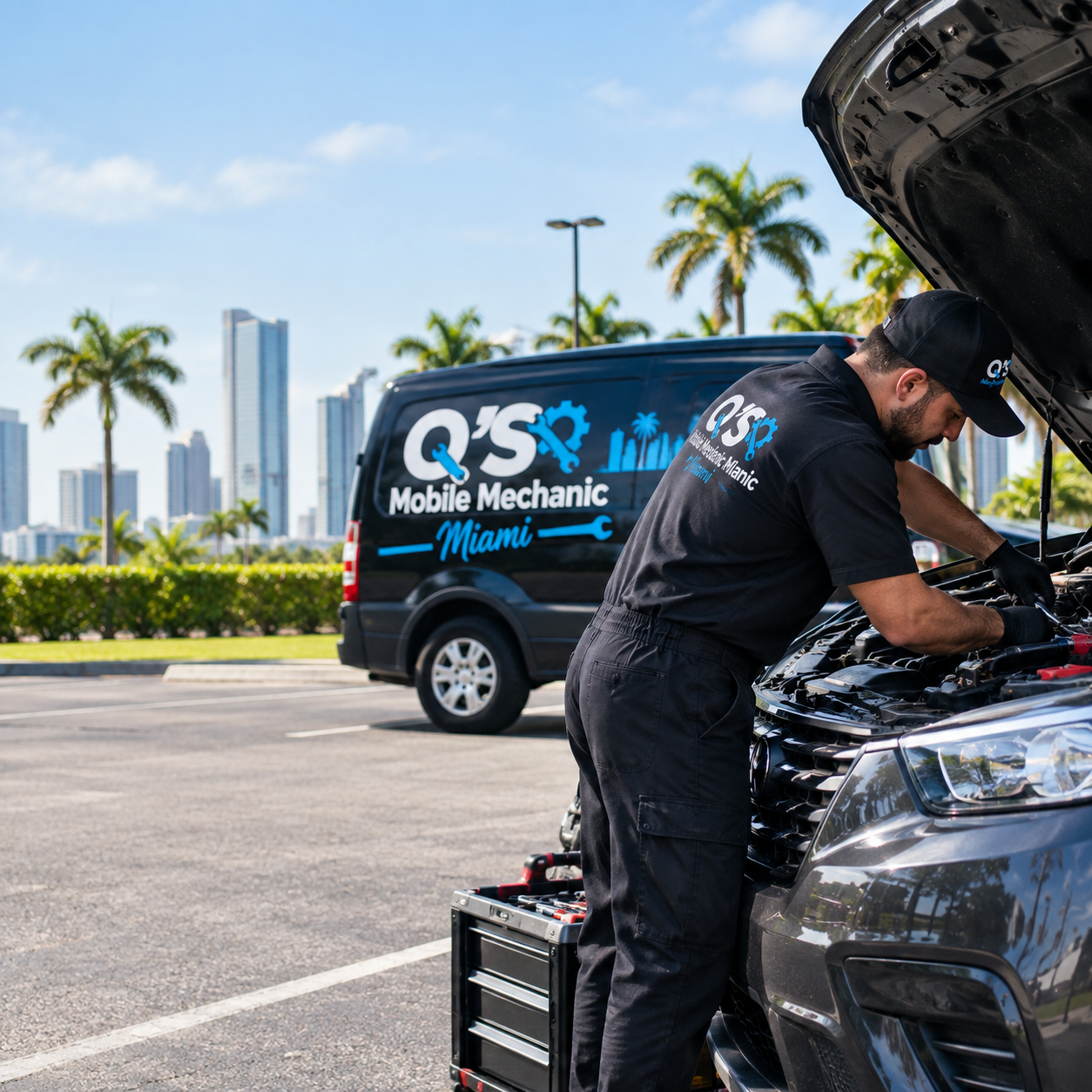
A repair that is a sensor, a coil, a gasket, a belt or a water pump is almost always worth doing, whatever the car is worth. An internal rebuild on a high mileage car with other tired systems is where the sums stop working.
Worth knowing: Get the diagnosis before the decision. Faults that sound internal often are not, and a misfire can be a forty dollar part or a major job.
Always repair. Brakes are a safety system, not an upgrade, and the cost is modest against any car. The only question is whether discs need replacing alongside pads.
Worth knowing: There is no scenario where driving on worn brakes is the economical choice. It damages discs and lengthens stopping distance.
Fluid, solenoid and sensor repairs are worth doing on nearly anything. A full rebuild is the genuine decision point, because it can approach or exceed the value of an older car.
Worth knowing: Have the fluid and codes checked first. A surprising number of shifting complaints are not internal wear at all.
Nearly always repair. Most electrical faults are a connector, a ground, a relay or a section of wiring, and the parts are inexpensive. The cost is in finding it, not fixing it.
Worth knowing: Beware of replacing components to chase a fault. That is how an electrical repair becomes expensive without ever being fixed.
Repair, and do it promptly. Hoses, thermostats, radiators and water pumps are all reasonable parts. Neglecting them is what causes the engine damage that forces the replace decision.
Worth knowing: A cooling repair postponed is the most common route to a head gasket, which is the repair that makes people scrap otherwise sound cars.
In Miami this one is not really optional. Hoses, filters, fans, switches and recharges are modest. A compressor plus condenser plus dryer on a very old car is a real decision.
Worth knowing: Get it tested before deciding. People replace compressors that were never the fault.
Almost every bad repair or replace decision is made on a guess about what is wrong. A proper diagnosis costs a fraction of either outcome and frequently changes the answer entirely, because the feared expensive fault turns out to be a sensor.
We will tell you plainly when a repair is not worth doing on your car. Nobody benefits from you spending a thousand dollars on a vehicle that needs two more repairs behind it, and saying so is the whole point of asking someone who works on them every day.
Call now for a diagnosis and an honest view on whether the car is worth it.